
Luxosy Interior Bangalore

Kitchen Design

Kitchen Design

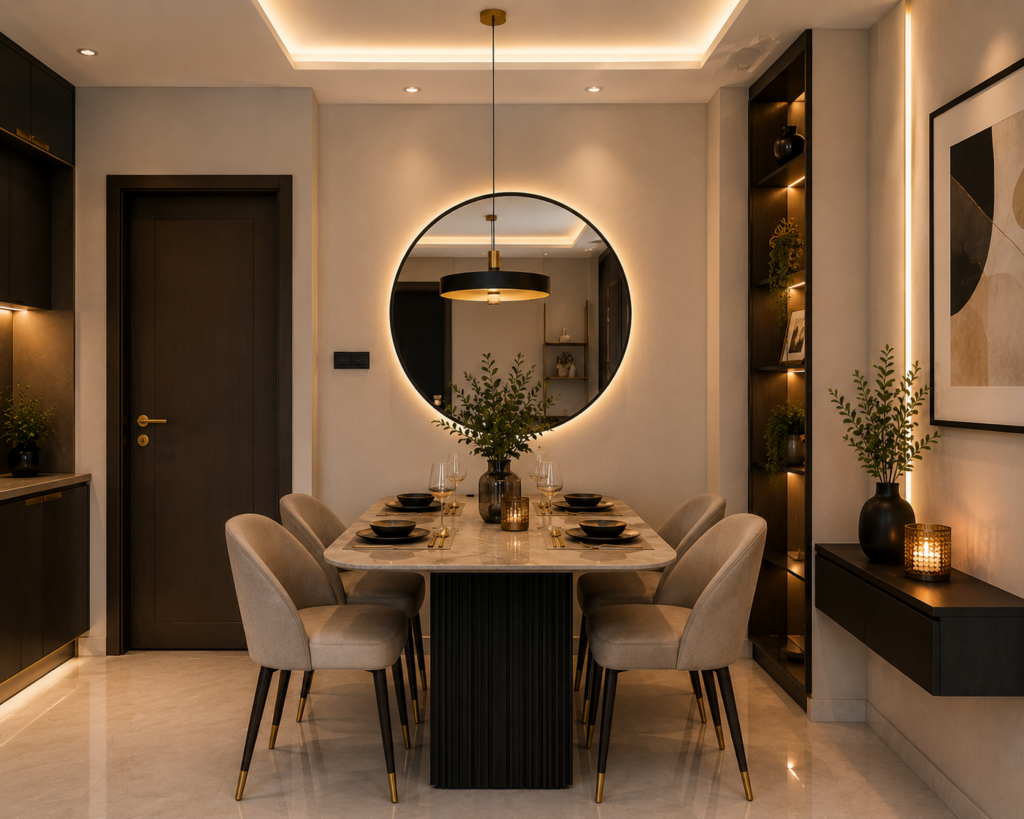
Space-Saving Dining Room Ideas for Compact Bangalore Homes

As urban living spaces become more compact, the traditional, sprawling dining room has become a luxury of the past. For homeowners in bustling metropolises like Bangalore, where high-rise 2BHK and 3BHK apartments dictate our square footage, creating a dedicated space for family meals can feel like a spatial puzzle. But a small footprint doesn’t mean you have to sacrifice style or eat dinner on the sofa every night. With intelligent spatial planning, the right furniture, and a touch of design psychology, even the tightest corner can be transformed into an elegant, functional dining area. In this expert guide, the design team at Luxosy Interior and Automation shares our proven E-E-A-T (Experience, Expertise, Authoritativeness, and Trustworthiness) backed strategies for planning the perfect dining room layout for small spaces. The Golden Rules of Small Dining Room Planning Before buying furniture or picking paint colors, you must understand the spatial mathematics of interior design. When Luxosy’s experts approach a compact floor plan, we strictly adhere to these three principles: 1. The 36-Inch Clearance Rule A common mistake homeowners make is buying a table that physically fits the space but leaves no room for human movement. You need a minimum of 36 inches (3 feet) of clearance between the edge of your dining table and the nearest wall or piece of furniture. This allows enough room for chairs to slide out and for people to walk behind seated guests comfortably. 2. Mind the “Visual Weight” In interior design, “visual weight” refers to how heavy an object looks, regardless of its actual mass. A solid, chunky wooden dining table feels heavy and clunky, making a small room feel cramped. Instead, opt for tables with slender metallic legs, glass tops, or sleek acrylic chairs. These allow light to pass through, creating an illusion of uninterrupted floor space. 3. Embrace Multi-Functionality In a compact apartment, your dining table often doubles as a work-from-home desk, a homework station, or a prep counter. Your layout must accommodate these dual purposes with smart nearby storage and appropriate task lighting. 5 Genius Dining Room Layouts for Small Spaces Depending on your apartment’s architecture, here are the top layouts our designers recommend for maximizing tight spaces: 1. The Banquette Nook (Built-in Seating) Best for: Unused corners or spaces near windows. Banquette seating (or booth seating) is an interior designer’s secret weapon for small spaces. By building a custom bench directly against the wall, you completely eliminate the need for clearance space behind the chairs on that side. 2. The Open-Plan Zone Best for: Studio apartments and seamless living-dining areas. When you don’t have a separate dining room, you have to create a “zone” within your living area. Instead of erecting physical walls, use visual dividers. 3. The Kitchen Peninsula / Breakfast Bar Best for: Narrow apartments and busy couples. If your layout allows, extending your kitchen counter to create a peninsula or a high-top breakfast bar is a brilliant space-saver. Pair it with backless bar stools that can tuck entirely underneath the counter when not in use. This layout integrates cooking, serving, and dining into one highly efficient zone, freeing up your living room entirely. 4. The Round Table Approach Best for: Square rooms and tight thoroughfares. A round pedestal table (a table with a single central base rather than four legs) is incredibly efficient. The lack of sharp corners makes it much easier to navigate around in a tight space. Furthermore, a central pedestal base means you can squeeze in an extra chair or two without guests banging their knees against table legs. 5. Foldable and Wall-Mounted Solutions Best for: Micro-apartments and spaces under 500 sq. ft. If you only need a dining space occasionally, consider a drop-leaf table or a custom wall-mounted folding table. When closed, it acts as a sleek console against the wall; when opened, it comfortably seats two to three people. Expert Styling Tips to Make Your Dining Area Look Bigger Layout is only half the battle. How you style the space dictates how large it feels. Why Choose Luxosy Interior for Your Small Space Design? Designing a compact area requires millimeter-perfect precision. A standard, off-the-shelf furniture piece will often waste valuable inches or disrupt the flow of your home. At Luxosy Interior and Automation, we specialize in bespoke, modular solutions tailored precisely to your apartment’s floor plan. Don’t let a small floor plan limit your lifestyle. A beautiful, functional dining space is entirely within reach. Contact Luxosy Interior and Automation today to book a consultation, and let’s design a space where great meals and great conversations can happen every day.
Kitchen Cabinet Colour Trends
Kitchen Design

2026 Guide: Hiring a Modular Kitchen Designer in Bangalore

Find the best kitchen interior designer in Bangalore by prioritising luxury finishes, climate-appropriate materials, smart space planning, and transparent pricing for a functional, elegant, and long-lasting kitchen. KEY INSIGHTS Why You Need a Professional Kitchen Interior Designer in Bangalore Many homeowners assume that hiring a local carpenter is enough. However, modern kitchen interior design requirements go far beyond simply assembling cabinets. Key Factors to Consider Before Choosing a Bangalore Kitchen Designer Choosing mindlessly can lead to years of daily dissatisfaction. Consider these factors carefully before signing a contract: 1. Experience in Modular Kitchens Look for a modular kitchen expert with proven project experience in Bangalore’s top residential societies. Ask for real-site images and walkthroughs, not just 3D renders. 2. Portfolio & Design Versatility Can they handle contemporary, minimal, traditional, and Vastu-compliant layouts? The best kitchen interior designers demonstrate versatility. At Luxosy Interior, our portfolio ranges from compact tech-bro minimalist setups to sprawling, family-centric traditional kitchens. 3. Quality of Materials & Hardware Always ask your designer about: 4. Customisation Capabilities Avoid standardised, cookie-cutter templates. Your cooking habits, storage needs, and family size must dictate the design—not the other way around. 5. Reviews & Local Reputation Search online reviews and client testimonials. A strong reputation in the Bangalore community is a massive indicator of trustworthiness and service quality. How to Shortlist the Best Kitchen Interior Designer Bangalore Has to Offer Step 1: Conduct Focused Research Search using targeted terms like ‘modular kitchen interior designer Bangalore’ or ‘best modular kitchen Luxosy Interior’ to find specialists. Analyze their project galleries and before-and-after transformations. Step 2: Compare 3–5 Designers Evaluate them based on communication clarity, budget flexibility, estimated project timelines, and transparency regarding material quality. Step 3: Visit Experience Centers Physically inspect finishes, shutters, and hardware. A reliable modular kitchen designer will confidently showcase material samples and explain the pros and cons of each. Step 4: Book a Design Consultation Observe whether they actually listen to your lifestyle needs—like needing a breakfast counter for quick morning meals before battling Silk Board traffic—or if they simply push standard packages. Questions to Ask Before Finalising a Kitchen Designer Before finalizing your choice, ensure you ask these critical questions: Understanding Modular Kitchen Prices in Bangalore Before you finalise a modular kitchen interior designer in Bangalore, you need a realistic understanding of what influences pricing. Many homeowners make the mistake of asking only for a lump-sum amount. Factors That Influence Your Quote Estimated Budget Categories Local Carpenters vs. Branded Designers: The Luxosy Advantage Many homeowners debate between local carpenters and large, faceless brands. The Middle Ground: Choosing a dedicated, high-quality firm like Luxosy Interior gives you the best of both worlds. You get the structured process, 3D visualization, and strict quality control of a premium brand, combined with the personalized attention, flexibility, and transparent pricing of a dedicated local expert. Common Mistakes to Avoid Popular Kitchen Interior Design Bangalore Trends (2026) Selecting the right kitchen interior designer in Bangalore is about securing durability, daily comfort, and smart budgeting. Compare your options, understand the costs, and prioritize quality over cheap shortcuts. When your kitchen is designed correctly by the experts at Luxosy Interior, it transforms from a mere cooking space into the functional, beautiful heart of your home.

Kitchen Design

What Influences Modular Kitchen Design Cost in Bangalore in 2026? Find Out Here!

Every Bangalore home has a kitchen as its centrepiece and it is more than just a kitchen; it has also become a community centre, an office, and a reflection of a person’s lifestyle prospective. More than ever, the need for modern, functional and technologically advanced modular kitchens will continue to grow in the next few years as Bengaluru, known as the Silicon Valley of India, is one of the fastest-growing cities in India. Nonetheless, for residents of areas such as Whitefield, Indiranagar and Jayanagar to bring their visions of decorating their living space to fruition, the biggest obstacle is determining the cost of their futures. To estimate what your costs may be in 2026, you need to look at existing trends and project potential changes based upon those trends. While the cost of living has always gone up with inflation, the most significant factor that affects the total cost of your modular kitchen will be your design decisions. The range of prices for a modular kitchen in Bengaluru can range from ₹2.5 Lakhs for an entry-level kitchen to being extremely lavish with a budget up to 20 Lakhs or more. This guide will discuss all the major components of your modular kitchen design for the Bengaluru marketplace in 2026.   The size of your kitchen project will have a huge impact on its cost – for instance, the cost of a tiny kitchenette in a one-bedroom apartment in Koramangala will be much lower than a large gourmet chef’s kitchen located in a large house in Sarjapur. Price is also determined by the amount of cabinetry you are purchasing; because modular kitchen cabinetry is sold by square footage (in other words, the more cabinet spaces you buy, the more you will pay for your kitchen), the cost becomes higher as the kitchen area increases. The layout of your kitchen can also affect the price of your kitchen project. If your kitchen has a straight or parallel configuration (as in a three-wall kitchen), it is typically the least expensive to build because it uses the simplest type of cabinetry. In contrast, L-shaped and U-shaped kitchen layouts often require specialised corner units (such as carousels) to maximise available storage space, which will increase the costs associated with hardware. An island configuration for your kitchen is the most expensive option when building your modular kitchen; in addition to increasing the size of your kitchen area and providing more countertop and storage space, an island also generally requires additional plumbing and electricity to install sinks and hobs because of its size. This increases the average modular kitchen cost by approximately 20% in 2026.   The Core Material: What Lies Beneath: Because of the extreme fluctuations in temperature and humidity that occur in Bangalore, it’s important that you select the correct ‘core’ material inside your cabinetry to give it the longest life possible. Boiling Water Proof (BWP) Plywood is the premier choice for areas that will have moisture such as a sink cabinet. While it is extremely durable and offers protection against moisture and termites, it also continues to be the most expensive material you can use for cabinetry and so by 2026 will remain as the preferred choice. Boiling Water Resistant (BWR) Plywood or Moisture Resistant (MR) Plywood falls into the mid-range category and will be an acceptable choice for upper cabinets and other drier areas of the kitchen. High-Density High Moisture Resistant (HDHMR) Board is starting to emerge as a strong candidate to be one of the top materials used for cabinetry in 2026 and beyond. In addition to having excellent screw holding capabilities, it also has superior moisture resistance and is priced slightly less than premium plywood. Particle Board and Medium Density Fiberboard (MDF) provides the most cost-effective materials for cabinetry, although you can use them to build shutters in dry areas. However, unless you’re creating a core structure for your cabinetry, it is not recommended to use them in the Indian market due to poor water resistance. By selecting your complete cabinetry from the premium BWP Plywood versus the low-end MDF, you can easily see a swing in cost of 30-40%. The Aesthetic Finish: The Visible Price Tag The outer appearance of your shutters is visible to your visitors and is a significant variable in terms of pricing. Laminates – The reliable choice for an Indian kitchen; Laminates offer durability against scratches, thousands of colors/textures (matte, gloss, textured wood), and are relatively inexpensive. In 2026, you can expect to continue to get great value from high-pressure laminates for your money. Acrylic – If you want a shiny, mirror-like finish, then acrylic is the way to go. Acrylic offers superior durability to laminate against scratching, but will cost you significantly more. It is a fingerprint-magnet and requires more upkeep to keep clean. PU (Polyurethane) Paint – A premium finish that is designed to be highly customizable and offers a seamless, sleek look in either matte or high-gloss finishes. PU paints require a great deal of labor to apply and will elevate the pricing of the project into the luxury range. Veneer – A veneer is a thin layer of real wood that has been glued onto a piece of plywood. Veneers can provide a wealth of real wood appeal and are stunningly beautiful, but will cost you substantially more than laminates and require a great deal of maintenance (polishing) over time.   The Hardware and Accessories: The “Hidden” Costs   Unexpectedly, this is often where budgets become severely overstretched. By 2026, homeowners will place considerably more emphasis on ergonomic design and operational convenience, which means that standard hinged doors (and the supporting hardware) will not meet their needs. Drawer Systems vs. Shelves – Ergonomically, drawers are more practical for use than deep shelves, but they typically require more expensive runner systems. Brand Naming – Selecting high-quality brands of hardware from Germany or Austria (i.e.: Hettich, Blum, Hafele) allows for the installation of soft-closing drawers and lift-up shutters to last for a minimum